
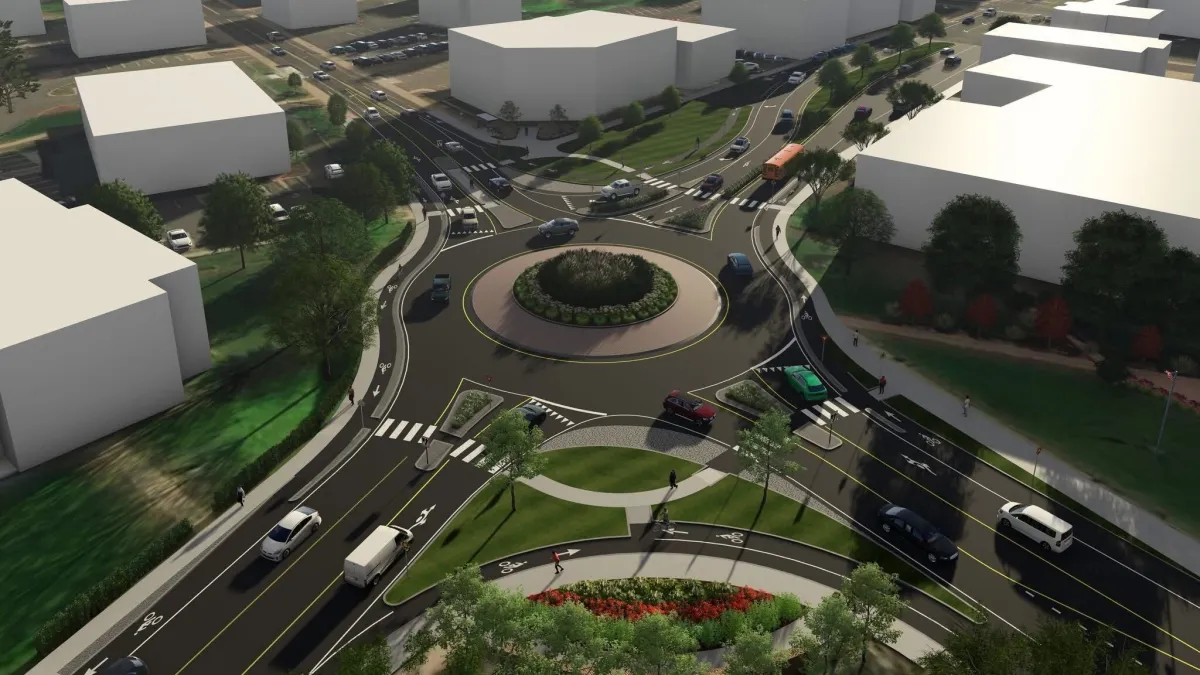
Manchester releases rendering of new roundabout proposed for downtown
A proposed roundabout at a busy Connecticut intersection is part of a broader effort to reshape a growing destination in Manchester.
The Town has shared a new rendering for a possible roundabout at Main Street and Center Street at the entrance to downtown, replacing the current traffic lights at the intersection with a design that includes bike lanes and pedestrian features.
Town manager Steve Stephanou said the project has been submitted to the state for a chance at grant funding. If awarded, Stephanou said design would happen next year and construction would be planned for 2028.
The rendering drew hundreds of comments online, with some concerned about the design and traffic flow.
“I think roundabouts, especially here in New England, can have a negative connotation,” Stephanous said.
He said unlike smaller rotaries, modern roundabouts have much more intentional traffic flow and are a proven method of reducing crashes and injuries.
What’s the difference between a roundabout and a rotary? Watch the difference below:
The roundabout is one piece of a larger project to improve Downtown Manchester from Center Street to Hartford Road. The goal, the town said, is to enhance Downtown’s appeal as a destination.
“I think we hear from all different age groups, demographics that people are looking for safe, walkable vibrant communities,” Stephanous said.
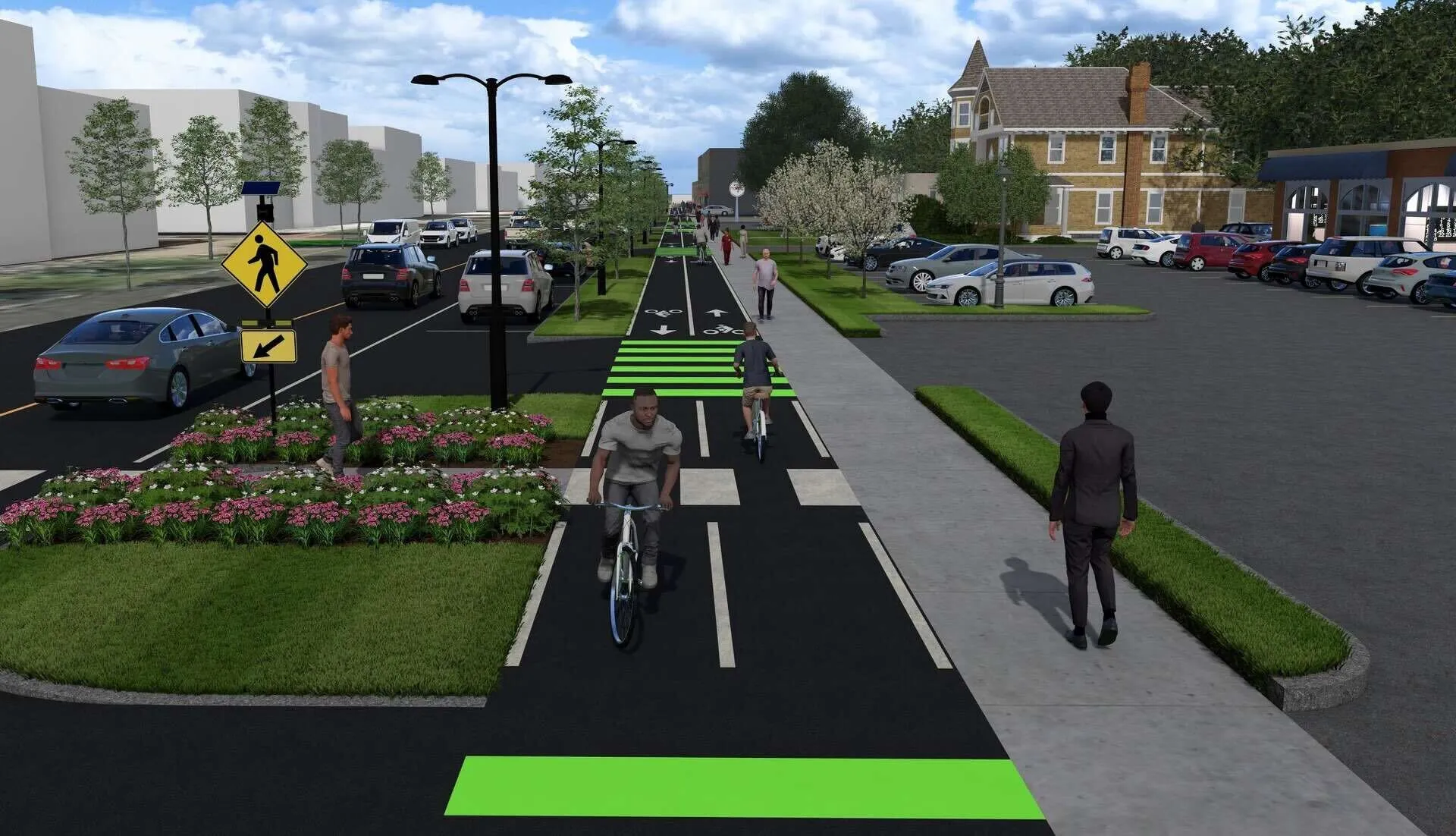
Along with another roundabout at Hartford Road and Main Street, a separated bike lane primarily along the west side of Main Street is planned.
In November, Governor Lamont announced $800,000 for the project as part of Connecticut’s Community Connectivity Grant program.
For residents like Collin Robinson, the changes cannot come soon enough.
“Every time I go down Main Street, I do have to think: is this the end?” he said. “The fact that there’s traffic pulling in and out of parking spaces, people weaving, it’s not safe for cyclists.”
He said between projects like the new library and potentially more apartments in the area, the proposed separated bike lane will improve connectivity and benefit walkers and cyclists of all ages.
“It speaks to more than just able-bodied cyclists like me, but people who are older and younger,” Robinson said.
“We have to look at all benefits, all users of the road. People like me on a bike, but also we can’t forget the cars are addressed and they’re just as important because of how many there are.”
He supports another part of the plan that would reduce Main Street from four lanes to three.
To accommodate traffic flow, town manager Stephanou said the traffic light system will be synced together.
He said the town’s math projects it will take about the same amount of time to move up and down Main Street even without the fourth lane “because there will be continuous traffic flow.”
“We think it’s going to take just as much time if not less to actually move up and down, but most importantly it’s about safety and making sure that people feel comfortable walking downtown and patronizing the businesses working there and living there.”
Brandon Farr, owner of Retro Junk on Main Street, said he has mixed feelings about the proposed changes: “I’m a middle of the road guy.”
“I’m very old school,” he said. “I’m not a huge fan of change, but I realize that progress is necessary for growth.”
Farr said he likes the possibility of more foot traffic and more places for people to sit outside, especially as a business that does no online sales.
However, he said he worries about whether traffic will backup on Main Street and whether pedestrians will be safe crossing in the roundabout.
“They can tell us how they think it’s going to go, but we’ll never really know until it happens,” he said.
He said he hopes the changes will continue bringing people downtown and wants to see beautification as part of the effort, including the empty lot that sits across the street from his business.
“I learned all I know about business by interacting with the community, and I’m really big on that. So hopefully, it just keeps bringing more people downtown.”
The Main Street improvement project is not without controversy. Last year, residents in the group “Save Downtown Manchester” filed a lawsuit in Hartford Superior Court.
The group circulated a petition asking the town to put forward an ordinance that preserves four travel lanes, protects angled parking, and requires a minimum of 110 public parking spaces at the Forest Street Lot, according to the group’s website.
The group’s website states that the lawsuit over whether the ordinance is valid is still pending in court.
NBC Connecticut reached out to “Save Downtown Manchester” but did not hear back before publication. We will update this story with any response.
Residents can learn more about the specifics of the project and continue to provide input here.
This story uses functionality that may not work in our app. Click here to open the story in your web browser.






From breaking news and local politics to art exhibitions, live music, high school sports, small businesses, and cultural events, we celebrate the people and places that make Connecticut unique.