

The Bloodroot Collective
By Gwyn Reutenauer
In the 1970s and 1980s, there were more than 230 feminist restaurants, cafes, and bookstores throughout the United States and Canada; Bloodroot, located in the Black Rock neighborhood of Bridgeport, remains as one of the longest-lasting. Bloodroot was started in 1977 by a collective of women committed to emerging lesbian feminist politics. They created the vegetarian-feminist bookstore and restaurant with the intention of becoming “a woman’s place.”
Bloodroot in the Women’s Movement
Collaborative work in the women’s movement allowed women to contextualize their experiences as functions of patriarchy and speak freely about their lives. The movement invigorated Bloodroot’s founding members, Betsey Beaven, Selma Miriam, and Samm Stockwell—quickly joined by Pat Shea and Noel Furie—to begin the work of the collective. The members of Bloodroot changed over time, but Miriam and Furie remained the consistent backbone of the operation.
Miriam and Furie came into adulthood from different backgrounds, but both faced fewer options for women. Each married and lived in Westport in the early 1970s with their children. Dissatisfied with their roles as mothers and wives in heterosexual marriages, they each began exploring lesbian rap groups—meeting groups where people could talk freely about a common idea—and consciousness raising groups.
Both women eventually divorced their husbands and further explored feminist politics and their lesbian identities. They met at a conference of the National Organization for Women (NOW) in Fairfield County. For a bit of time after they met, Furie and Miriam were lovers. In an oral history conducted in 2009, Furie said she was attracted to Miriam because of her brilliance, creativity, and anger. Furie said, “She was expressing something that I was just barely beginning to define.”
Inside Bloodroot image by Gwyn Reutenauer
Building of Bloodroot
After Miriam got divorced in 1975, she started the first iteration of Bloodroot: a Wednesday night co-op exchange out of her home in Westport. Miriam cooked all week for the meal and other women sold things like “non-sexist children’s books” and jewelry. It was a chance for women to meet, organize, and exchange ideas. Miriam decided she wanted to do the work of Bloodroot full-time.
Miriam’s mother found the building that would become Bloodroot’s home: an old machine shop on a dead-end street along Long Island Sound. In 1976, with $18,000 she had saved over years of landscaping work, financial support from her parents, and a loan from the bank, Miriam bought the building.
Part of the challenge of Bloodroot was to create a feminist business in a world with very few existing models. Miriam had decided on a restaurant because she knew how to cook, and she wanted Bloodroot to be a celebration of different cultures and foods. The Collective decided to cook vegetarian food after a friend introduced them to the intersections of feminism and animal rights.
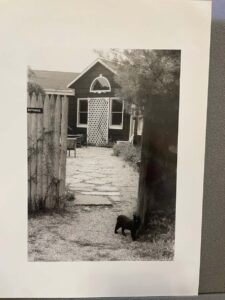
One of the many cats of Bloodroot standing at the entrance to the restaurant. Photo by Noel Furie. Accessed through the Yale Special Archives Bloodroot Collective records. Used through Public Domain.
The members chose everything in the space with intention, including the people they worked with. They hired two feminist architects to redesign the space, along with a woman carpenter, accountant, and attorney. To Miriam, a collective meant equal investment in time and energy but not equal financial investment. Out of a desire not to further the servant-master relationship of most restaurants, the Collective decided on their self-service policy. There were no servers and therefore was no tipping, so part-time workers were paid minimum wage. One review at the time of Bloodroot’s opening remarked positively on the self-service aspect as it forced customers to interact with one another in line and with those cooking the food.
At the time of their opening, friends of the Collective worried no one would come due to the remote location of the restaurant. Bloodroot did not believe in advertising and spent a lot of the early days answering phone calls to provide directions. They operated on the belief that if someone needed it, they would find it. Of course, not all customers shared Bloodroot’s point of view. A review in the New York Times in 1978 described Bloodroot as having “a make-do quality that you will either like or loathe. It is also militantly feminist, though an occasional man can be seen in the small dining room.”
A Hub of Lesbian Community
Inside the doors of Bloodroot, the working and living environment was uniquely lesbian-centered. Letters donated to the Yale archives by Miriam and Furie offer a glimpse into the Collective’s role as a hub for the conflict and collaboration of the lesbian feminist movement. The collection, along with materials that document events Bloodroot hosted—readings, anniversary parties, political discussions, etc.,—includes Miriam and Furie’s personal and intellectual correspondence with writers and activists such as Adrienne Rich, Audre Lorde, and Andrea Dworkin.
The two also had pen-pal-style correspondences with lesbians across the country. In 1979, Leaf Seligman, a writer from Tennessee, wrote to Selma, “What you have chosen to do with your life greatly increases the richness of my own.” One did not need to be in the physical space of Bloodroot to experience its impact.
Book publishing
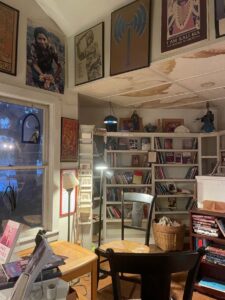
Bloodroot bookstore image by Gwyn Reutenauer
The choice to be a bookstore came easily for Bloodroot because of the number of feminist books published at the time. In the 1970s and 80s, many women created independent presses to get their books published, reviewed, and distributed. In addition to feminist books, the bookstore included reference information for patrons to access. References included information on international women’s movements and pamphlets with advice, such as how to request directions for a non-traumatic abortion and understanding job rights while pregnant.
In 1980, Bloodroot published their first cookbook, The Political Palette: A Feminist Vegetarian Cookbook. Members chipped in equal amounts of money, Miriam wrote the recipes, and Furie took the photographs. They created their own publishing company, Sanguinaria Publishing, to retain all control of the cookbook. Next to vegetarian recipes and insight on ethical vegetarianism, the book features excerpts of feminist lesbian writing. Furie said the book provided a place where they could “hoot and holler” about their vision and politics. They went on to publish two more cookbooks in The Political Palette series and in 2007, they published The Best of Bloodroot with Anamoly Press.
Activism in Bridgeport
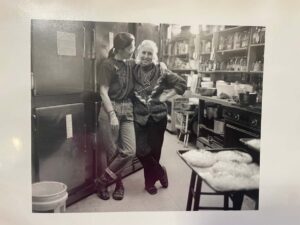
Noel Furie and Selma Miriam arm in arm in the Bloodroot kitchen. Accessed through the Yale Special Archives Bloodroot Collective records. Used through Public Domain.
The location of Bloodroot and its commitment to the Bridgeport community has always been central to their success. In a 2020 interview with Seasoned, a Connecticut Public podcast, Miriam said, “The treasure of Bridgeport is the diversity of its people.”
Miriam and Furie had been politically active before starting Bloodroot; in 1975, they were elected president and vice president, respectively, of the Westport Weston chapter of NOW. In the early 80s, they organized a petition in the neighborhood when the body of water in front of Bloodroot, Burr Creek, was threatened with development. They collected hundreds of signatures and were successful in conserving the space. They were also involved in activism against sexual violence, participating in New Haven Take Back the Night rallies.
In the 1980s and 90s, Furie organized against the building of a casino in Bridgeport, worked with local elementary school students to create an international herb garden, and organized West Side Vegetarian Block Parties where neighbors shared food and learned about the benefits of eating less meat. The activist work of the Collaborative and the efforts led by Furie and Miriam were sometimes separate, but their work informed one another and came from the same desire to improve the lives of Bridgeport residents.
Bloodroot Today
Decades later, Bloodroot remains in business. Diversity of food and culture is still central to the vision of Bloodroot. In the 2010s, Furie and Miriam began hiring women from the Mercy Center in
Inside Bloodroot image by Gwyn Reutenauer
Bridgeport, a learning center that helps women gain literacy, job skills, and improve their quality of life. Hiring from the Mercy Center gave Miriam and Furie the opportunity to “know people different from themselves.”
Selma Miriam died in February 2025; she was two weeks shy of 90 years old. She never retired from Bloodroot and lived in her Westport home with her life partner Carolanne Curry. Furie can still be found at Bloodroot providing vegetarian food and feminist politics.
Bloodroot continues to gain attention and has been the subject of two recent documentaries. Furie was excited to archive the Collective’s materials at Yale so that younger generations could understand the importance of Bloodroot. She said the legacy of Bloodroot is “walking around on two feet”: all the people who made up Bloodroot.
Gwyn Reutenauer is a historian and early childhood educator. She researched the Bloodroot Collective during her time as an intern with Connecticut Humanities
The post The Bloodroot Collective first appeared on Connecticut History | a CTHumanities Project.






From breaking news and local politics to art exhibitions, live music, high school sports, small businesses, and cultural events, we celebrate the people and places that make Connecticut unique.